
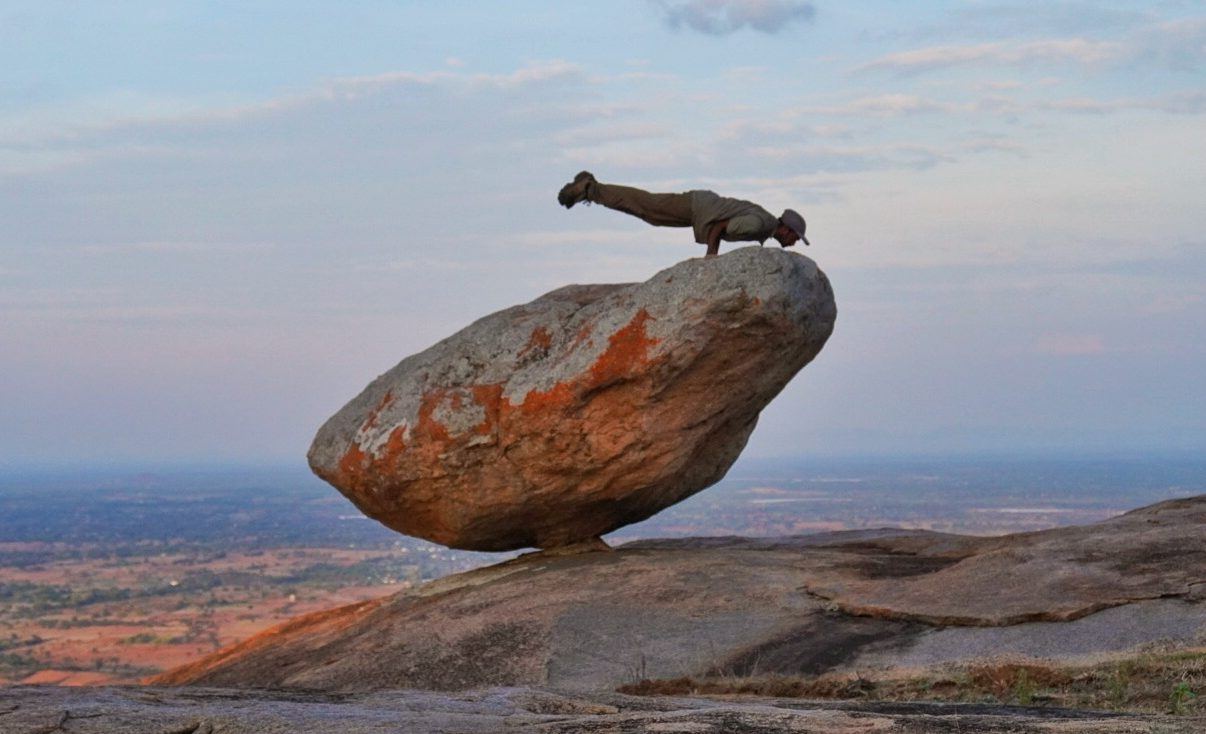
The Rock Climber
The boulders of Devarayanadurga are not obstacles on the landscape; they are its spine.
The granite of Devarayanadurga has been climbed — in a sense — for generations. The yogis of the lineage practised their dīkṣās in its caves and bettas. The Swamiji himself passed through caves at Siddarabetta, Ketenahalli, Ramadevara Betta and Nandi Betta.
Climbing for me is how I honour that stone: with the body, honestly, one hold at a time.
The Stone and the Stillness
A rock face is an honest teacher. It does not flatter, negotiate or explain; it simply demands. Climbing trains the same attention that yoga trains — breath, balance, and the complete presence of the body in the present moment.
There is also a silence in climbing that fieldwork cannot always give: the silence of a body fully occupied, on stone that has held this forest together for millennia.
The Cave Lineage
The caves of this landscape carry our family's history: the great cave at Ketenahalli where the Swamiji remained in tapas without food for nearly twelve years; the Narasimha Swamy cave where Kaivara Thatha performed tapas; the Ramadevara Betta cave where he received the siddha paṭṭa.
When I climb these hills, I move through the same places the lineage moved through — and the stone keeps the memory.
Climbing as Conservation Perspective
From a boulder top, the forest reveals itself differently: the canopy, the corridors, the places where animal movement flows and where it breaks. Many of my observations about habitat connectivity in Devarayanadurga began from exactly this higher ground.
“
The stone does not flatter, negotiate or explain. It simply demands — and in that, it is the truest teacher.
Raghunandan S.